
Full-Arch Dental Implants in Minneapolis, MN: What to Compare Before Choosing a Treatment Plan
Key Takeaways
- Full-arch treatment can replace all teeth in an upper arch, lower arch, or both.
- Fixed full-arch implants, implant-supported overdentures, and traditional dentures each involve different tradeoffs.
- Bone volume, gum health, bite forces, medical history, personal goals, and budget all shape the recommended plan.
- Same-day teeth are often temporary teeth, while the final restoration is placed after healing.
- An itemized estimate is more useful than an advertised starting price.
For Minneapolis residents with failing teeth or loose dentures, the choice can affect everyday moments, from enjoying a meal with family to speaking comfortably at work. When researching all-on-4 dental implants Minneapolis MN, Parkway Dental Center offers a local overview of full-mouth implant options, including its All-on-6 approach. The Minneapolis practice focuses on full-arch implant dentistry. It has an in-house dental laboratory, making it a valuable resource for patients seeking to understand fixed and removable replacement options before committing to treatment.
A full-arch plan should never be selected by a label alone. “All-on-4,” “All-on-6,” and “teeth in a day” can describe useful approaches, but the right choice depends on an individual examination, imaging, and a candid discussion about maintenance, timing, and costs.
What Full-Arch Tooth Replacement Means
Full-arch tooth replacement restores an entire upper or lower row of teeth. It may be fixed in place by implants or removable for cleaning. With implant treatment, small posts placed in the jawbone support either a bridge or a denture. Replacing missing teeth can improve comfort, chewing ability, speech, and appearance, but each option requires an ongoing commitment to care.
The Main Treatment Options
All-on-4 and Similar Fixed Full-Arch Treatments
All-on-4 generally uses four strategically placed implants to support a complete arch of replacement teeth. In suitable cases, a temporary fixed bridge may be attached on the day of surgery. This approach requires careful planning because implant position, bone quality, and bite forces all matter.
All-on-6 Full-Arch Restorations
All-on-6 uses six or more implants to support a full arch. Additional implants may be appropriate when anatomy and the restorative design support that plan, but more implants are not automatically better. The number should be based on the patient’s available bone, bite, and clinical needs.
Implant-Supported Overdentures
An implant-supported overdenture is removable but attaches to implants for added stability. It can be easier to clean than a fixed bridge and may have a lower initial cost. Attachments, denture teeth, and the denture base may still require periodic repairs, replacements, or adjustments.
Traditional Dentures
Traditional dentures remain a practical non-surgical option. They are generally faster to make and have a lower initial cost, but they can move, cause sore spots, and change fit as oral tissues and bone change over time.
How the Options Compare
- All-on-4: Usually fixed, with fewer implant sites. It may be a good fit for selected patients with adequate stability and a suitable treatment design.
- All-on-6: Usually fixed, with added implant support in appropriate cases. It may require more available bone and can increase treatment costs.
- Implant-supported overdenture: Removable, stable, and easier to clean outside the mouth. It requires care for attachments and denture components.
- Traditional denture:Removable, non-surgical, and less expensive up front. It may require adhesives, relines, and future adjustments.
Who May Be a Candidate
People often consider full-arch treatment because of extensive tooth loss, many failing teeth, or dentures that no longer feel secure. A dentist must assess the gums, bite, jaw joints, remaining teeth, medical conditions, medications, smoking status, and ability to heal. Three-dimensional imaging can help evaluate bone volume and important anatomical structures. Some patients need extractions, gum treatment, bone grafting, or a staged plan before implants can be placed.
The Planning and Treatment Process
Consultation, Imaging, and Preparation
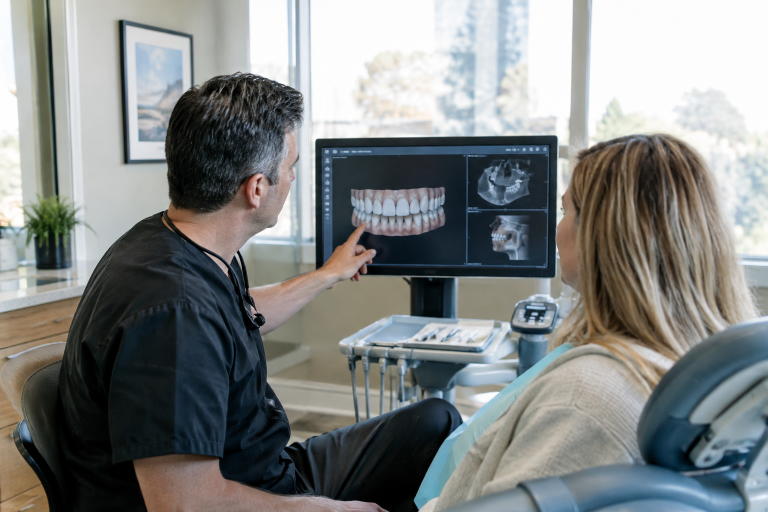
The process begins with a health review, oral examination, and discussion of goals. Digital scans and cone beam imaging may be used to plan the final tooth position before surgery. Preparatory care can include periodontal treatment, extractions, grafting, or a temporary denture.
Implants, Temporary Teeth, and Healing
During surgery, implants are placed in planned positions. A patient may receive a temporary fixed bridge or removable denture while healing occurs. As the full-arch teeth-in-a-day process explains, same-day teeth are commonly temporary, with final teeth made after the implants have had time to integrate with the jawbone. Follow-up visits allow the dental team to monitor healing, hygiene, and bite changes before delivering the final restoration.
Choosing Restoration Materials
Final restorations may include acrylic, composite, porcelain, or zirconia components. These materials differ in appearance, weight, strength, repairability, and cost. A patient with heavy bite forces may need a different design from someone prioritizing easy repair or a lighter-feeling restoration. Ask whether the estimate includes both the temporary teeth and the final teeth, as well as the planned material for each.
Costs, Insurance, and Financing
Full-arch costs vary because plans may include different numbers of implants, extractions, grafting, imaging, surgical guides, sedation, temporary teeth, final materials, laboratory work, and follow-up care. Dental insurance may cover only limited portions of treatment, but coverage varies by policy. Request a written, itemized estimate and compare what is included rather than comparing only a starting price.
Risks, Maintenance, and Long-Term Care
Implant treatment has possible biological and technical complications, including infection, inflammation around implants, bone loss, implant failure, discomfort, and damage to the restoration. Long-term research on complete-arch fixed implant rehabilitation has reported high implant and prosthesis survival in one patient group while also documenting biological and technical complications. That is why full-arch treatment is not maintenance-free.
Daily brushing, carefully cleaning beneath a fixed bridge, and attending professional maintenance visits are essential. A dental team may recommend interdental brushes, flossing aids, water flossers, or other tools based on the restoration design and a patient’s dexterity.
Questions to Ask Before Treatment
- Is treatment planned for one arch or both?
- Which teeth can be saved, and which require extraction?
- How many implants are planned, and why?
- Will I need grafting or another preparatory procedure?
- Will my temporary teeth be fixed or removable?
- What material will be used for the final restoration?
- What does the written estimate include and exclude?
- What maintenance and repair plan will I need in the long term?
Final Thoughts
The best full-arch option is not necessarily the fastest, least expensive, or most implant-heavy plan. Minneapolis patients can make a more confident decision by seeking a clear diagnosis, reviewing alternatives, understanding the healing timeline, and confirming the full cost and maintenance expectations before treatment begins.
- How Salt Lake City, Utah Businesses Can Build Network Resilience for Weather, Growth, and Hybrid Work - October 18, 2026
- How to Plan a Bathroom Remodel for Safer Movement and Easier Cleaning - October 18, 2026
- Full-Arch Dental Implants in Minneapolis, MN: What to Compare Before Choosing a Treatment Plan - October 18, 2026


